
And I’ve been thinking about some of the ways we wait in silence – Pt 3
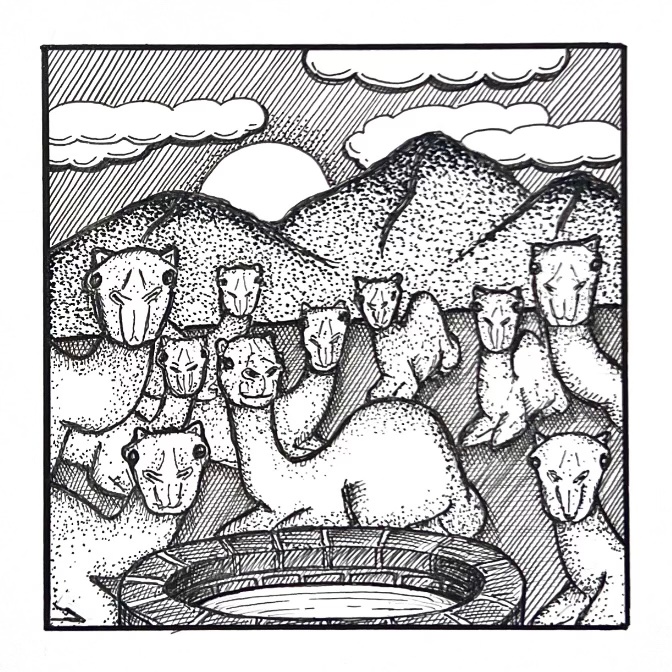
“The man gazed at her in silence to learn whether or not the Lord had made his journey successful.” – Genesis 24:21
After traveling a long distance to his master’s homeland, Abraham’s servant sat by a well to find a wife for Abraham’s son.
The story tells us that before leaving, the servant had gathered ten of Abraham’s camels as well as the finest jewelry and gold. He would come prepared to bless the potential bride and her family.
After arriving in the city of Nahor, the man went straight to the town’s well and made the camels to kneel nearby. He remained standing, asking Abraham’s God to show lovingkindness to his master by making his own journey a success.
In the conclusion of his prayer, the man came up with a plan.
He would ask a woman for sip to drink, and if she replied with an offer to water his camels as well, then she’d be the answer to his prayer and the bride for his master’s son.
Even before he finished speaking to Abraham’s God and to himself, Rebekah, a woman of noticeable attraction came out to the well, bringing her mentionable beauty and a lone jar upon her shoulder.
Now, with the woman in his sights, he runs to her to initiate his test.
“Please let me sip a little water from your jar.” “Drink, my lord,” she said and quickly lowered her jar upon her hand and gave him a drink. When she had finished giving him a drink, she said, “I will draw for your camels also, until they have finished drinking.” – Genesis 24:17-19
Though her reply was not what he had expected, it was ultimately what he had hoped for.
She did not offer to water his camels as he took a sip, but waited for him to drink his fill before saying another word.
It’s subtle, but dramatic.
“As Meir Sternberg acutely observes, this long delay before she finally produces the requisite offer to water the camels is a heart-stopper, enough to lead the servant in grave momentary doubt as to whether God has answered his prayer.” 1
And this would not be the last time the man will wait.
After she eventually offers to water the camels, the scripture says “she hurried and emptied her jug into the trough and she ran again to the well to draw water and drew water for his camels.”
Robert Alter points to the near heroic nature of her efforts.
“This is the closest anyone comes in Genesis to a feat of “Homeric” heroism… A camel after a long desert journey drinks many gallons of water, and there are ten camels here to water, so Rebekah hurrying down the steps of the well would have had to be a nonstop blur of motion in order to carry up all this water in her single jug.”2
Rebekah, the heroic water gatherer hurries about, running back and forth to draw water from the well as she quickly fills her jar and pours out refreshment for Abraham’s camels.
And she does this on repeat.
The server (who doesn’t seem like much of a helper) is a picture in contrast as the story reveals.
“And the man was staring at her, keeping silent, to know whether the Lord had granted success to his journey.” – Genesis 24:21 (Alter)
He waits in silence even though he already knew she was the one!
She already passed his test. But, as a way of watching his hopes become sight, he silently waits as the woman fulfills the answer he was longing for.
Like going to see the sunrise when you already know the sun will come up.
Like getting quietly comfortable with your favorite book, even though you already know how the story will end.
Sometimes the silence in waiting is exactly what we need to prepare us for the joy that will follow.
Needless to say, the camels drank their fill and Rebekah was the answer the man had journeyed to find.
As we often do in the season of Advent, we wait in silence. And like the servant by the well, sometimes our waiting is to make sure Jesus is the One we came for.
“Did you really come to die? Did you really say you would come again? Does the story of Joseph and Mary, the shepherds and the angels mean something for us today? Does the promise of you coming on the clouds merit our waiting? And will you really come through?”
In one sense, we already know Christ will come, because Christ has come. And he will come through, because he has already come through.
But, in another sense, we wait in silence because it’s the only way to stand in attention as he comes to us in this hour of Advent.
If we are not careful to silently stand in gazing attention, we will miss the Lord who is right now filling the jars and satisfying the thirsty.
We are the servants of Abraham who wait in silence to see if our journey was worth traveling. And the Lord, like Rebekah, proves to be more than satisfying. More beautiful than we expected. More generous than to simply offer a sip. More gracious than we can wrap our heads around.
Jesus will prove to be the satisfaction of our Advent journey.
And the reverse will also be true.
Jesus, the son of Abraham, gazes at us, the arriving daughters of Rebekah, and patiently waits for his bride. Will his silence be satisfied with the joy of our advent? Will he find refreshment from the jars of our faithfulness?
Advent is just as much about our arrival as his coming. And at this hour and in this moment we collectively wait in silence for the marriage celebration.
The silence in waiting might be exactly what we need to prepare us for the joy that will follow.
So, let us stand with expectation. Let us gaze and stare in silence as we observe the nourishing advent of God’s fulfillment.
Even the camels kneel in wait for the supper to begin.
Pease allow these remarks from Karl Rahner to conclude my thoughts.
“You must continue to come more and more. What has already taken place in the roots of all reality must be made more and more apparent. The false appearance of our world, the shabby pretense that it has not been liberated from finiteness through Your assuming finiteness into Your own life, must be more and more thoroughly rooted out and destroyed.
Behold, You come. And Your coming is neither past nor future, but the present, which has only to reach its fulfilment. Now it is still the one single hour of Your Advent, at the end of which we too shall have found out that You have really come.
O God who is to come, grant me the grace to live now, in the hour of Your Advent, in such a way that I may merit to live in You forever, in the blissful hour of Your Eternity.” – Karl Rahner 3
Robert Alter, The Hebrew Bible: A Translation With Commentary, W. W. Norton & Company, 2019, p. 79
Robert Alter, The Hebrew Bible: A Translation With Commentary, W. W. Norton & Company, 2019, p. 80
Karl Rahner “Encounters with Silence” The Newman Press. Originally published by Verla Felizian Rauch, Innsbruck, Austria (first edition in 1938) as Wrote ins Schwiegen, pp. 86-87
 Jason Martin
Leave a comment